
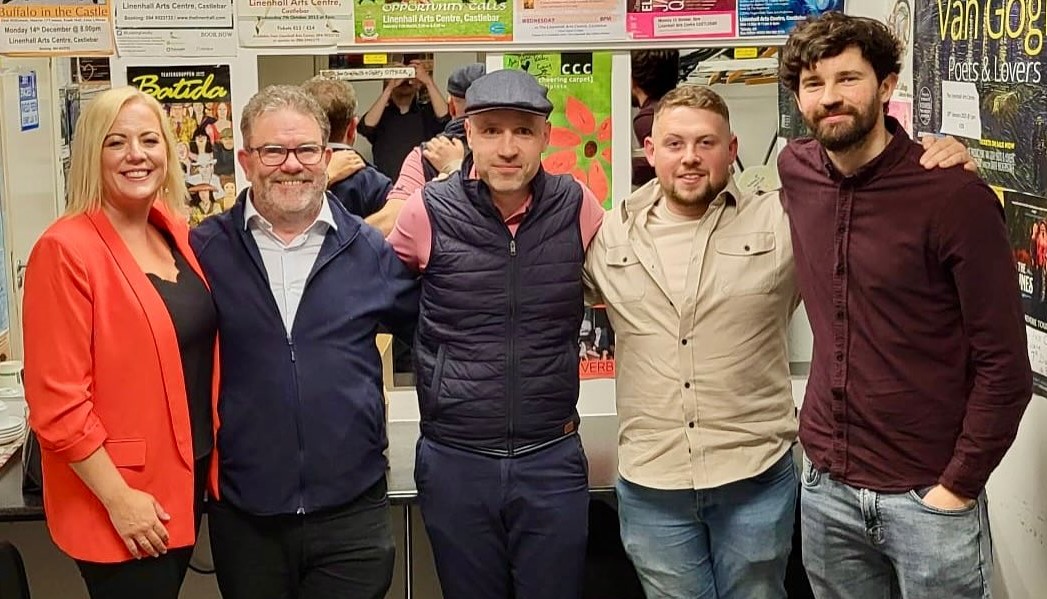
On Thursday night, I found myself on a stage talking about movies. And, never wishing to overexplain any situation, that is where the title of this week’s blog post comes from.
‘But how did this come about?’ I hear you cry. And I
would gently exhort you to calm down a little because you’ve been quite stressed lately and it’s worrying me. Go and have a green tea or a lie down or something and
come back and read the rest of this later. We’ll all still be here.
Better? Good.
This ‘Celebration of Mayo Indie Short Films and Filmmakers’ was the brainchild of Carnacon’s Ruaidhrí Hallinan, who co-wrote and co-produced the excellent short film ‘Where the Old Man Lives’ along with Kilmaine's Eamonn Keane. This short film was directed by Sonya O’Donoghue and it stars Michael Harding, Ruth McCabe, and Michael Patric.
Ruaidhrí, who I very much
enjoyed meeting on the night, is a virtual powerhouse of creative filmic energy.
In an answer to an audience question, he described producing as the
hardest-by-far part of getting a film made. This is not hard to believe as Ruaidhrí
carries with him a drive and enthusiasm for his work that is both impressive and
mildly contagious… I need to get something done, like now! In one recounted
story, Ruaidhrí described how he tried to get hold of a contact number for the
an elusive and brilliant actor and eventually tracked him down by schmoozing
a helpless temporary intern on a phone. In the very nicest possible way, the story evoked for
me an image of Brian Cox in Manhunter; “I'll bet you have a call caddie
right next to your phone… well zip that little pointer right on down to the
letter 'H'.
‘Where the Old Man Lives’ is a very fine short film. It
deals with subjects that are highly relevant to the modern Irish rural community.
Themes of loneliness, isolation, societal fear, and aging. It is beautifully produced,
written, and exceptionally well performed by a glowing cast. It was the final film shown at our film evening and you should check it
out when you get a chance. I feel sure it will come your way.
Ruaidhrí devised the evening around this fine film and he generously
sought out a number of other County Mayo Film People to come and show our
wares and to share the event with him. This was an act of generosity combined with an accurate realisation that audiences enjoy a well-curated selection of short films with
the added fun of meeting the film makers. This was borne out by a full-house audience
in the Linenhall Arts Centre and a very warm and enthusiastic response to the
evening as a whole.
There were four films shown in all and each of them stood
out in their own way. One of them stood out, for me in particular, because I
wrote it - but we’ll get to that. The evening was MCed by Cróna Esler, who I’ve known
for a long while and who played her customary blinder in keeping everything
rolling smoothly and keeping us all (mostly) in check.
The first film was ‘Rapacious’ written, directed, and
produced by Eamonn Keane. For me, this was the most beautiful of the four films.
Imagery, photography, and sound were of an extraordinarily high quality and as
a showcase for the super digital projection facilities at The Linenhall, it was
the perfect choice. A lot of the audience would have been familiar with the
Moore Hall location in which it was shot but I feel a viewer who did not know
the area would be struck by the beauty and colour of the world where the film
is set and the shocking incongruity of the ruined mansion rising out of the woods.
The third film was ‘Vanilla’ and one of the absolute
highlights of the evening was getting to meet writer and director Tony
O'Donnell. I think Tony kind-of won the evening in many ways. His easy going,
slightly laid back approach to the interview and Q&A session engaged everyone
in the nicest possible way. However, behind the gentle exterior lies a
considerable writing and directing talent. Tony assembled a cast for his very
first short film that is nothing short of astonishing and when one sees the quality
of writing in his film, one understands why they all journeyed down to a much-loved
Belmullet pub for two days filming with a man who had never made a film before.
They obviously saw what we, the audience, saw the other night. A slice of raw
filmic talent with a world of possibilities now unfolding in front of him.
Heady stuff.
The second film was ours, and by ‘ours’ I mean director
Richard Keaney’s and mine. Well, I’m only the writer so it’s Richard’s film
really but let’s not argue about it.’ Joey Had Never Been Out of the City’ has
been around the festivals now. It’s won awards for acting and writing and it even
won Best International Short at the Bedford film festival, which was darned
nice of them. This is my second cinematic collaboration with Richard and we’re
both working hard to do more. We did ‘Getting In’ a few years ago and that
did well at festivals too. This was my first time to see ‘Joey’ on a big screen
and with the added bonus of an audience of nearly two hundred people. It was a buzz for sure. In
the interview/Q&A, afterward, I did my usual schtick, I’m not the best at selling myself or bigging myself up but I’m proud of what Richie and I
have pulled off here, with practically zero resources and a lot of help from industry friends: a little film that plays and
works well.
If you want to know about me, you can read the 800,000 or so words that sit on this darned blog. There’s plenty about me here, if you want it, but that’s quite enough about me for now.
Some words about Richard Keaney are in order though.
Richard is pure filmmaker at heart. As long as I’ve known him, which must be the best part of twenty years, cinema, and everything cinematic has been a huge part of his life. His knowledge of the medium is Wikipediac (did I just make that word up?) and he sees everything, considers everything, and remembers everything. He even works in the medium.
He is driven to make movies and, more importantly, to make the best movies he can. Richard is still a very young man. We met when he acted as a teen in a number of my theatre plays. He shared those stages with virtual unknowns such as Sally Rooney. Even then, the love of film was abundantly clear. I wrote a part in my favourite teen play ‘Midnight in the Theatre of Blood’ to reflect his movie-buff character and he played the part.
Apart
from the films he has made from my own scripts, he has also written and directed
‘Scope,’ ‘Late Arrivals’ and ‘Recoil’ among others.
On a personal level, Richard is the gentlemanliest (did I make that word up too?), kindest, most generous, most enthusiastic person you could ever hope to meet. I think the main thing Richard and I share is a quiet but driving ambition to make the very best film that we can. It’s as simple as that.
Richard has the talent to be a great film maker. But is there more that can be done to help him, and all the other upcoming film makers, achieve this goal?
If there was an overarching theme to the evening, I feel that this was it.
There are a number good funding schemes for short and
feature films here in Ireland but, by understandable necessity, that funding tends
to go to people and bodies who are already three or four steps down the road.
The most wonderful initiative would be one that provided some funding opportunities for those who are just
one or one-and-a-half steps down the same road. People who have already shown
enough commitment and passion to make a short film or two. Not beginners, not
without evident talent, but just needing a small-but-crucial boost and a modicum of encouragement to be able to push on through. To go that little bit bigger and that
little bit better.
The difference between me being a writer every day and not being a writer at all was, I feel, just a few small comradely claps on the back from people who knew their stuff. If there was such a thing as that for the wonderful, driven film makers who can’t quite yet convince the established funding programmes to take them on… well, I think that would be a fine, fine, thing.
If in doubt that this
could work, just seek out see the work that is being done these days, here in Mayo and all
over the place, with zero help and practically zero budget, by people who know
their stuff and who are driven to do it well. A couple of grand might make
their next project possible. It might even make their next project their best
project yet. Think about it.
Thanks very much to everyone who made Thursday night possible.
It was pretty good, wasn’t it?


